Beyond the Lobby: 5 Immersive Indoor Signage Trends Transforming Melbourne Offices
The modern office experience now feels more like entering a gallery or tech hub than a traditional workspace. Walls communicate, floors guide movement, and Indoor signage Melbourne helps ensure every visual cue serves a clear and purposeful role.
This shift reflects a broader workplace evolution. Companies across Melbourne now treat interiors as part of branding, navigation, and employee experience. Indoor signage Melbourne plays a key role here, with Top Commercial Signage solutions helping offices improve visibility, organization, and brand identity.
Beyond logos in the lobby, signage now flows through corridors, meeting zones, breakout spaces, and collaborative areas. It influences how teams move, how visitors orient themselves, and even how company culture appears in physical form.
Digital layers, environmental design, interactive surfaces, and sustainable materials are transforming office interiors into immersive environments. Designers increasingly blend Custom Office Graphics Melbourne, digital navigation systems, and sustainable indoor business signs to create workplaces that feel alive.
How Workplace Signage Quietly Shapes Office Culture
A common misconception is that signage simply directs people to the right room. In practice, Indoor signage Melbourne quietly shapes behavior inside an office. A well-placed visual cue can reduce hesitation in hallways, prevent congestion around shared spaces, and encourage people to explore collaborative areas rather than retreating to desks.
During a recent office retrofit in the Docklands precinct, an interesting issue surfaced. The client had invested heavily in breakout zones meant for spontaneous collaboration. Yet staff rarely used them. The problem wasn’t furniture or acoustics. The spaces were simply invisible from the main circulation paths.
Poor signage design creates the opposite effect. A surprising number of offices rely on temporary printed labels stuck to doors or inconsistent fonts scattered throughout the building. That inconsistency gradually erodes the visual identity of a workspace. Over time, employees start ignoring signage altogether. Effective indoor signage Melbourne systems rely on consistency, subtle placement, and visual logic that people can understand without consciously thinking about it.
Comparing Traditional vs Immersive Office Signage
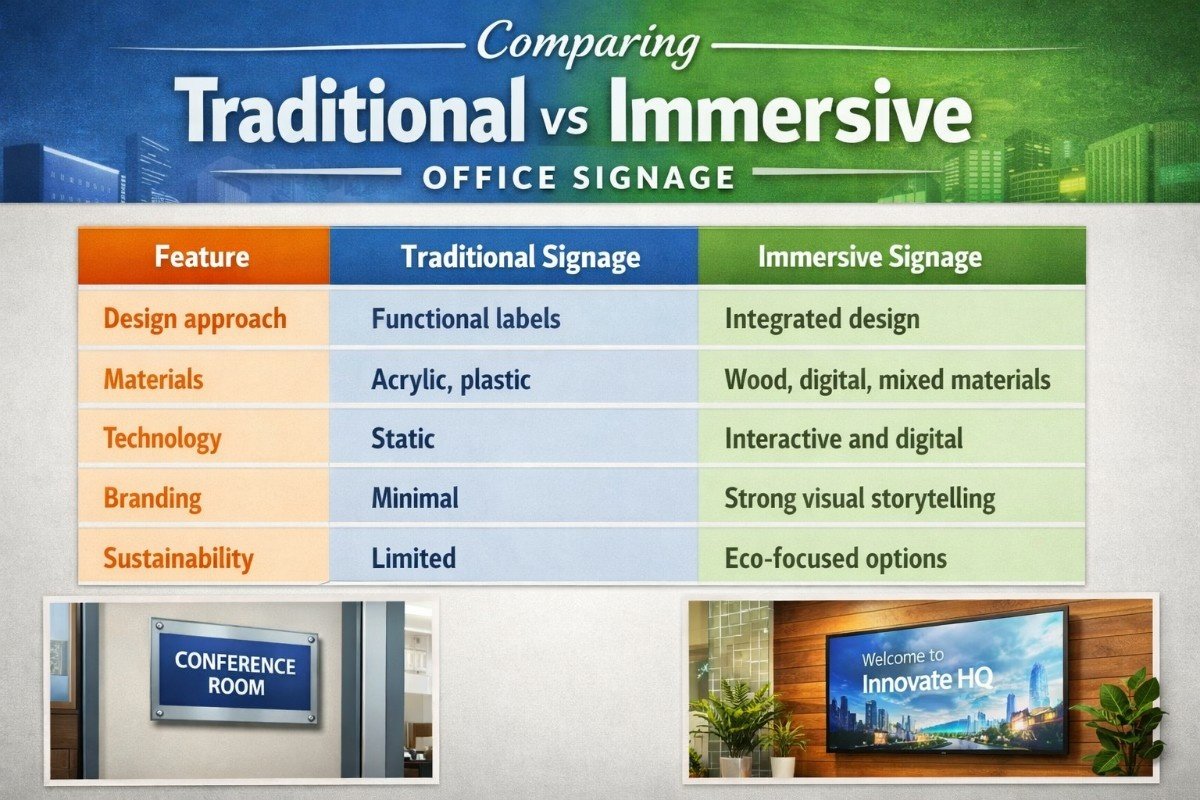
This shift explains why Custom Office Graphics Melbourne and Digital Wayfinding Solutions Australia are becoming a core element of workplace design strategies.
Immersive Environmental Graphics Changing Office Walls
Office walls were once neutral to avoid distraction, but that approach has changed in Melbourne’s creative and tech sectors. Today, walls act as storytelling platforms with large graphics across corridors and meeting areas while also supporting workplace safety signage requirements in modern offices.
Environmental graphics also solve a practical problem: scale. Large workplaces can feel disorienting if every surface looks the same. By introducing bold visual zones, employees instinctively remember locations. A team might say, "Meet near the blue corridor wall” rather than referring to a room number.
Not every attempt succeeds, though. Some organizations overdo the concept by filling every wall with branding slogans or oversized logos. The result feels more like walking through a marketing campaign than a workplace. Balanced indoor signage Melbourne design avoids visual fatigue. Strategic placement, restraint in messaging, and thoughtful use of color tend to create stronger results than covering every surface with graphics.
Why Wayfinding Systems Matter in Large Offices
The complexity of modern workplaces has grown significantly. Flexible seating arrangements, shared meeting rooms, Indoor signage Melbourne, visitor management systems, and hybrid work policies create a constantly changing environment. In buildings with multiple tenants or large floorplates, navigation becomes surprisingly complicated without a structured wayfinding strategy.
Wayfinding really hits its stride when physical signs work hand-in-hand with subtle cues in the environment. You might have floor patterns pulling people down a hallway, while wall graphics confirm they’re headed the right way. In big office towers, digital directories are great for reception, but if these layers don't talk to each other, navigating the space becomes a headache for any first-time visitor.
It’s easy to overlook just how much time staff waste playing human GPS. During one office move, a survey found employees were losing chunks of their day just walking visitors to meeting rooms. A few minutes here and there don't seem like much, but across a huge team, it adds up fast. Smart indoor signage Melbourne setups cut that friction out, quietly making the whole office run a lot smoother.
Digital Wayfinding Systems Reshaping Office Navigation
Digital navigation tools are increasingly used in Melbourne workplaces, especially in tech offices and co-working spaces with frequent visitors. Indoor signage Melbourne now often includes interactive directories that help guests find meeting rooms or departments and even show real-time room availability.
These systems offer flexibility that traditional signage cannot match. Room names change, departments relocate, and companies grow. With digital navigation, updates happen instantly without replacing physical panels. However, installing digital systems is not always a perfect solution. Maintenance costs, software updates, and occasional technical glitches introduce new operational considerations.
There is a psychological side to this, too. Most people still lean toward a simple visual cue over a complicated screen. If you have to tap a display just to find the toilets, the whole experience feels clunky. That is exactly why the best indoor signage Melbourne plans mix digital hubs with old-school directional signs rather than ditching the basics entirely.
Sustainable Materials Redefining Office Signage Design
Sustainability is now influencing Melbourne office design. Indoor signage Melbourne increasingly uses reclaimed timber, recycled acrylics, and low-VOC inks, offering both environmentally responsible choices and a distinctive, high-end look compared to standard plastic signs.
But going green does come with trade-offs. Some recycled stuff just isn't as tough as the traditional materials. Wood signs, for example, might need a bit more TLC in a busy hallway. Companies sometimes forget these practical realities when picking "eco" options.
Sustainability is a win, but only if it’s balanced with how well the signs hold up over time.
Even with those hurdles, sustainable materials are taking off. Offices chasing green certifications are leaning into Indoor Signage Melbourne systems built from responsible sources. The end result usually feels a lot warmer and more "real" than standard panels, especially in offices designed with a natural, biophilic vibe.
Indoor Signage Melbourne Trends Beyond the Reception Area
Many businesses still treat signage as a reception-only feature. A polished logo wall sits behind the front desk, while the rest of the office relies on small printed labels. Indoor signage Melbourne plays a much broader role, and the most effective systems extend well beyond the lobby to support navigation and branding throughout the workplace.
From quiet zones to breakout areas, every corner of the office needs a consistent visual thread. Subtle cues help the team get around a confusing floor plan without breaking their focus. Eventually, these signs become second nature; people just "get" the logic of the building without having to think about it.
Another overlooked area involves internal branding. Reception walls often carry company values or mission statements, yet employees rarely spend time there. Placing cultural messaging along everyday circulation routes keeps those messages visible in daily work life. Strategic indoor signage Melbourne installations can quietly reinforce company identity across the entire office environment.
Mistakes Companies Make With Office Signage Plans
One of the most frequent mistakes in office fit-outs is leaving signage decisions until the final stages of construction. At that point, budgets are usually tight, and available wall space has already been determined by other design elements. The result often becomes a compromise rather than a coherent signage strategy.
You also have to watch out for "signage creep", where different departments start making their own signs. You end up with a messy patchwork of fonts and colors that ruins the office aesthetic. Sticking to a strict set of standards is the only way to stop that slow drift into visual chaos.
Budgeting for this can be tricky. Some firms blow the whole budget on a flashy lobby sign but leave the rest of the office a maze. Others focus so much on the "how-to-get-there" that they forget the branding side of things. A balanced indoor signage Melbourne strategy usually delivers the best value in the long run.
The Future of Indoor Signage in Melbourne Offices
As Melbourne companies continue rethinking office environments, signage will likely evolve further.
Several emerging directions already appear:
AI-driven navigation screens
augmented reality wayfinding
personalised digital displays
adaptive signage for hybrid workplaces
These developments suggest indoor signage Melbourne will continue merging architecture, technology, and storytelling.
Blending Architecture and Signage for Cohesive Design
The most impressive offices are the ones where the signs and the architecture feel like a single unit. We're seeing indoor signage Melbourne being woven directly into the lighting or the wall textures themselves, rather than just being bolted on later. This creates a much more cohesive, "meant-to-be-there" feel for the whole workspace.
You’ll often see glass walls finished with subtle frostings that name the meeting rooms without blocking the sun. On the ground, floor inlays can steer people through open-plan zones without adding to the visual noise. Even LED strips are doing double duty now, acting as glowing breadcrumbs to lead the way down main hallways.
Pulling off that kind of seamless look really comes down to getting architects, designers, and signage pros in the same room early on. If you wait until the end of the build to think about signs, you lose that chance to make the space feel truly unified. The most innovative companies are now treating indoor signage Melbourne as a core part of the building’s "bones" rather than just a last-minute decoration.
Balancing Branding, Navigation, and Workplace Aesthetics
Office signage ultimately performs three roles at once: brand communication, navigation, and environmental design. Achieving balance between these functions is surprisingly difficult. Too much branding can make a workspace feel promotional rather than professional. Too much functional signage can make interiors feel clinical.
Experienced designers often approach signage the way lighting designers approach illumination. Some elements provide clear functional guidance, while others simply shape the atmosphere. That layered strategy allows signage to work quietly in the background without overwhelming the space.
If there is one rule to follow, it’s restraint. You don't need a graphic on every single wall or a sign in every hallway. Often, a few strategically placed pieces do more work than a total blanket of signs. Well-thought-out indoor signage Melbourne setups age better and stay useful even when the office layout gets a shuffle.
Conclusion
Office signage ultimately performs three roles at once: brand communication, navigation, and environmental design. Indoor signage Melbourne must balance these functions carefully. Too much branding can make a workspace feel promotional rather than professional, while too much functional signage can make interiors feel clinical.
Modern workplaces now use a mix of Custom Office Graphics Melbourne and Digital Wayfinding Solutions. Modern workplaces in Australia utilize a combination of custom office graphics Melbourne and sustainable indoor business signs to maintain a dynamic and visually appealing environment. A smart strategy boosts the vibe and functionality of the room. Get in touch with us to chat about a custom signage plan for your space.
Frequently Asked Question
1. What does indoor office signage typically include?
Indoor office signage usually includes directional signs, meeting room identifiers, branded wall graphics, safety signage, and digital directories. Indoor signage Melbourne increasingly combines functional navigation with visual branding elements that support workplace identity and employee experience.
2. Why do large offices invest heavily in signage systems?
Large offices rely on structured signage to reduce confusion and improve navigation efficiency. Without a clear system, visitors and employees frequently interrupt work to ask for directions. Effective signage quietly improves workflow by guiding people through complex office layouts.
3. Is digital signage replacing traditional office signs?
Digital signage is becoming more common, particularly in reception areas and meeting room management systems. However, Indoor signage Melbourne still relies heavily on traditional physical signs because people depend on simple visual cues for quick navigation within office environments.
4. How early should signage planning begin during office design?
Ideally, you want to start talking about signs while the interior is still on the drawing board. Tying the signs into the architecture from day one means better visibility and a much cleaner look than trying to bolt things onto the walls once the builders have left.
5. What materials are commonly used in modern office signage?
Most modern office signs use a mix of acrylic, glass, aluminum, or timber. These days, plenty of Melbourne businesses are also hunting for sustainable materials that fit their green policies and help them hit those tough environmental building standards.
6. Does good signage actually improve workplace productivity?
Indirectly, yes. Clear signage reduces interruptions, shortens navigation time, and helps visitors move through buildings efficiently. Over time, these small improvements reduce friction in daily operations and create a smoother workplace experience.